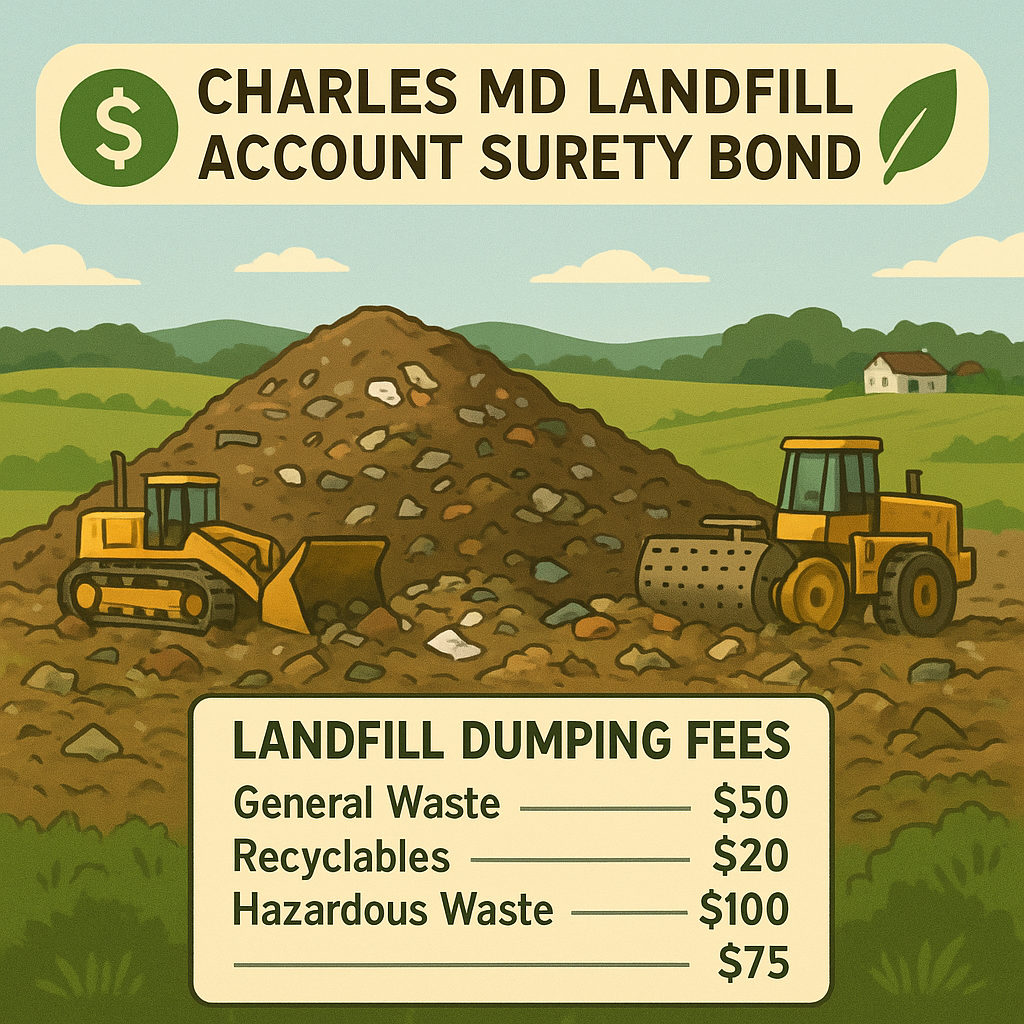
Thinking about where your trash goes after you toss it in the dumpster? If you run a business in Charles County, Maryland, that generates waste—whether you’re a contractor tearing out drywall, a landscaper hauling branches, or a property manager cleaning out an old unit—chances are you’ll find yourself headed to the county landfill. But before you load up the truck and hit the road, there’s a piece of paperwork you might not expect: a landfill account surety bond. And, of course, you’ll need to understand the actual dumping fees to keep your costs in check.
This might sound like just another bureaucratic hoop, but it’s actually a simple system designed to keep the landfill running smoothly. Let’s break it all down in plain English so you know exactly what to expect, how much it costs, and why it exists in the first place.
What Exactly Is a Charles County Landfill Account Surety Bond?
Imagine you’ve just opened a tab at a neighborhood café. The owner trusts you to pay at the end of the month because you’re a regular. Now picture the county landfill as that café, but on a much larger scale. Instead of coffee, they’re taking tons of construction debris, household junk, and everything in between. The “tab” here is your landfill account—and the surety bond is the financial promise that backs up your word.
A landfill account surety bond is a three-party agreement. The county (the obligee) asks you, the hauler or business owner (the principal), to purchase a bond from a bonding company (the surety). This bond guarantees that if you fail to pay your dumping fees, the bonding company will step in and cover the bill—up to the bond amount. Then, the bonding company will come after you for reimbursement. Think of it as a safety net for the county, not insurance for you.
Why does this matter? Because the landfill processes hundreds of vehicles every week. Tracking down unpaid debts from individual haulers would be a logistical nightmare. The bond streamlines everything and keeps the focus on, well, the actual trash.
Why Does Charles County Require a Bond for Landfill Accounts?
It all boils down to risk management. The county operates the landfill as a public service, but it’s also a business that needs to cover its operating costs. Every time a truck tips a load of shingles, old furniture, or yard waste, the county incurs expenses for compacting, covering, and eventually closing that cell of the landfill. If a hauler were to rack up thousands of dollars in fees and then disappear, taxpayers would be left holding the bag.
The surety bond requirement flips that scenario on its head. It tells the county, “We’ve vetted this account holder, and we’re confident they’ll pay.” It also encourages haulers to stay on top of their bills because any claim against their bond can hurt their credit and future ability to get bonded. In short, it’s a practical tool that protects public funds while giving businesses a clear path to use the landfill responsibly.
How Do Landfill Dumping Fees Work in Charles County?
Now let’s talk about the other half of the equation: what you actually pay when you arrive at the scale house. Dumping fees, sometimes called tipping fees, are the charges for disposing of solid waste at the Charles County Landfill and Recycling Center. These fees vary based on three main factors:
- Type of waste: Municipal solid waste (your everyday household trash) is often at one rate, while construction and demolition debris, yard waste, or recyclable materials may have different—sometimes lower—rates. Clean loads of dirt or concrete might even be accepted at a discount because they can be used as cover material.
- Weight: The golden rule at any landfill is: the heavier the load, the more you pay. Vehicles are weighed upon entry and exit, and you’re billed for the difference. That’s why you’ll often see large dump trucks rolling slowly over a giant scale before and after tipping.
- Vehicle type: Pickup trucks, box trucks, and commercial roll-off containers can all face different minimum fees. For instance, a homeowner with a pick-up full of old carpet might pay a flat fee if the load is under a certain weight, while a 30-yard container from a demo site will be strictly pay-by-the-ton.
So how much can you expect to hand over? Rates shift from time to time, but as an example, a typical mixed municipal waste load might run somewhere around $60 to $70 per ton. Yard waste and clean wood could be significantly cheaper. A small pickup truck with a couple of hundred pounds of random household junk? You might get away with a minimum charge that feels more like a few bucks. The best move is always to check the Charles County Department of Public Works website or call the landfill directly before your trip. They can give you the current fee schedule so there are no surprises.
Getting Your Bond: How Much Does It Cost and Where Do You Start?
Here’s the good news: you don’t have to pay the full bond amount upfront. You pay a premium, which is a small percentage of the total bond value. For example, if the county requires a $10,000 landfill account bond, your annual premium might fall somewhere between $100 and $300, depending heavily on your personal or business credit score. The stronger your financial history, the less you’ll pay. Some bonding agencies even offer instant online quotes, so you can see your rate in minutes.
The process usually looks something like this:
- Open an account with the county: Visit the solid waste division’s office or their website and complete the landfill account application. They’ll tell you the exact bond amount you need, which is often based on your estimated monthly dumping volume.
- Contact a surety bond agency: Look for an agency familiar with Maryland commercial bonds. You’ll provide basic business details and perhaps undergo a soft credit check. If you’re a brand-new business with no credit history, don’t worry—many programs exist for first-time bond buyers.
- Purchase the bond and file it: Once approved, you’ll pay the premium and receive your bond document. The agency may file it directly with the county or give it to you to hand in. After that, your account is active, and you can start hauling.
One smart tip: ask the bonding agency if the bond can be bundled with other business insurance policies or if there’s a discount for paying annually versus monthly. Over time, a good relationship with your surety provider can save you real money.
What Happens If You Don’t Pay Your Landfill Bill?
Let’s walk through a real-world scenario. Suppose you’re a contractor in the middle of a busy season, and you’ve run up $3,000 in dumping charges over two months. For whatever reason, you miss the payment deadline. The county will first send reminders and late notices. If the bill remains unpaid, they can file a claim against your surety bond. The bonding company then investigates and, if the debt is valid, pays the county the outstanding amount. But here’s the kicker: you still owe every penny. The surety will demand reimbursement from you, and they have legal teeth to garnish wages, place liens on assets, or take you to court. Plus, your ability to get bonded in the future takes a serious hit. It’s a path nobody wants to walk.
This safety net is precisely why the system works. It protects the county’s cash flow without letting bad actors slip through the cracks. For honest business owners, it’s just a background requirement that rarely, if ever, becomes a problem.
Common Questions You Might Be Asking
Is the bond the same as insurance?
No. Insurance protects you from unexpected losses—like a fire or an accident. A surety bond protects the county from your financial default. If a claim is paid, you’re on the hook to repay the bonding company. Think of it like a co-signed loan rather than a policy.
Do I need a bond if I’m just a homeowner cleaning out my garage?
Almost always, no. The bond requirement applies to commercial accounts and frequent haulers. A resident with a pickup truck and a load of broken patio furniture typically pays cash or card at the scale and drives away, no account needed. If you plan to make multiple trips over a short period, ask the landfill staff if a temporary account makes sense—but that’s rare.
Can I pay a cash deposit instead of getting a bond?
Some jurisdictions allow a cash bond, where you deposit the full bond amount with the county. However, most haulers prefer the surety bond route because it keeps their cash free for daily operations. Charles County’s current policy leans toward the commercial surety bond, but checking with their solid waste department is always wise.
A Few Words of Caution and a Path Forward
Before you fire up the engine and head for Billingsley Road, take ten minutes to do your homework. The landfill’s rules about what’s accepted, what’s banned (like hazardous waste or certain electronics), and how to sort your load can save you from frustrating rejections or extra fees. And while the bond process may feel like a minor hurdle, it’s a key part of keeping Charles County’s waste disposal fair and financially sound for everyone.
Still have questions? Reach out to a local surety bond professional who understands Maryland regulations, or get in touch with the Charles County Department of Public Works. They deal with these situations every day and can point you in the right direction. A little planning now means your next trip to the landfill will be nothing but a smooth, predictable stop on your busy schedule.