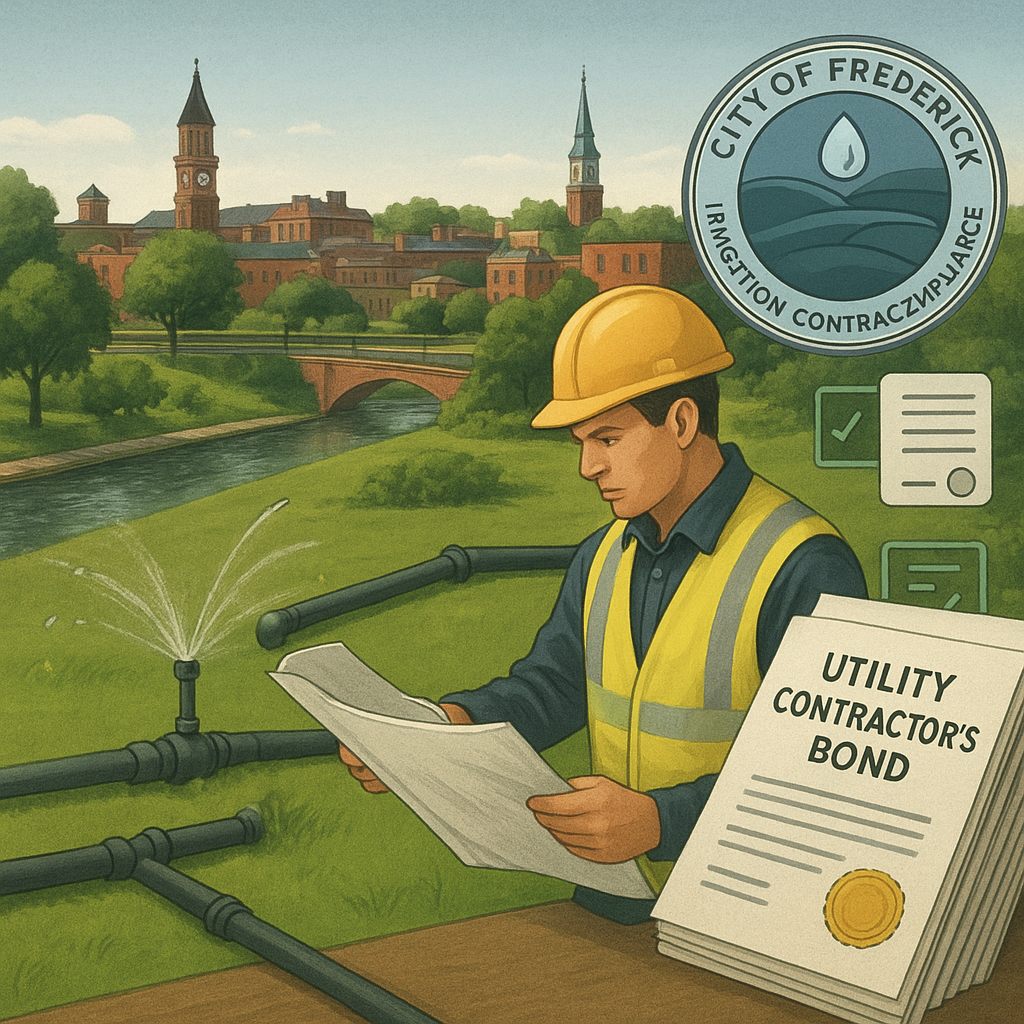
If you’ve ever dug a trench in your yard to run a new water line, or watched a crew tear up a street to fix a sewer pipe, you’ve witnessed the kind of work that needs a special promise. In Frederick City, Maryland, that promise often comes in the form of a utility contractor’s bond. Think of it like a safety deposit you’d leave when renting a tool — but on a much bigger, city-scale level. Let’s break down what this bond is, why it matters, and how it keeps everyone playing by the rules.
What is a Utility Contractor’s Bond, Anyway?
Imagine a handshake deal where a contractor tells the city, “I’ll do the job right, and I’ll fix any mess I make.” The bond is the legal version of that handshake. It’s a three-party agreement: the contractor (called the principal), the city requiring the bond (the obligee), and the insurance company backing it (the surety). If the contractor fails to follow codes, damages public property, or leaves a project half-finished, the city can file a claim against the bond. The surety company then pays to fix the problem — and later collects that money from the contractor. So, it’s not a free pass; it’s a financial guarantee that responsibilities are met.
In Frederick, this bond is a non-negotiable ticket to working within public rights-of-way, like roads, sidewalks, and utility easements. Without it, you simply can’t pull a permit for the job. And for good reason — nobody wants a contractor to dig up a street, lay a pipe, and vanish without restoring the pavement.
Why Does Frederick City Require This Bond?
City governments care deeply about two things: public safety and protecting taxpayer dollars. When a contractor opens up the ground in a public area, the potential for things to go sideways is real. A poorly backfilled trench might cause a sinkhole. A broken water main could flood a basement. If the contractor isn’t financially on the hook, the city — and ultimately residents — would have to foot the repair bill. The bond ensures that the responsible party is always accountable.
Frederick’s regulations are part of the city’s right-of-way management. They want to make sure any company working in streets or on public utilities has not just the skills, but the financial backing to stand behind their work for a set period. It’s like a warranty you’d get on a new appliance, but for underground pipes and wires.
Who Needs a Utility Contractor Bond in Frederick?
Not every handyman needs one. This requirement typically applies to businesses that physically alter public property or work on utility systems that connect to the city’s mains. You’ll likely need a bond if you are:
- A general utility contractor installing or repairing water lines, sewer laterals, storm drains, or gas pipes within the city’s right-of-way.
- An excavation contractor whose work involves cutting into streets, curbs, gutters, or sidewalks.
- A directional drilling company boring under public roads for fiber optics, electrical conduits, or cable lines.
- An irrigation contractor performing work that touches municipal water connections or crosses public spaces.
Essentially, if your project involves a permit from Frederick City’s Department of Public Works or Engineering, there’s a strong chance a utility contractor’s bond will be in your list of must-haves. The exact bond amount can vary based on the scope of work, but it’s often set by city code or as a blanket requirement for all utility contractors.
What About Irrigation Contractors? Compliance-Only Bonds
Here’s where things get specific — and you might have noticed the term “irrigation contractor – compliance only” floating around. In many places, irrigation contractors who install lawn sprinklers, drip systems, and landscape watering networks also touch the water supply. In Frederick, if an irrigation job requires tapping into the municipal water system or working in the right-of-way, the city may demand a compliance-only bond. This isn’t about performance or finishing the job per se; it’s strictly about following the rules.
A compliance-only bond guarantees that the contractor will adhere to all city codes, ordinances, and regulations. It’s narrower in focus. If the contractor connects a backflow preventer incorrectly, violates water conservation rules, or fails to turn the water off at the street after work, the city can use the bond to cover fines and corrective actions. This type of bond is often smaller in amount than a full performance bond, but it still offers vital protection for the community.
How Does the Bond Protect the Public?
Let’s paint a picture. A utility crew replaces a sewer line under a neighborhood street. Everything looks fine until a few months later, when the pavement starts sinking. Residents now have a hazard right outside their driveways. Because the contractor held a $25,000 bond with the city, the city can file a claim, get the money to repatch the road properly, and the surety chases the contractor for reimbursement. The homeowner doesn’t pay a cent. That’s the beauty of the system.
The bond also acts as a deterrent. Contractors know that cutting corners could lead to claims that hike up their future bond premiums or make it impossible to get bonded again. So, there’s a built-in incentive to do quality work the first time. It’s a bit like a driver’s points system — too many infractions, and you’re out of the game.
How Much Does a Utility Contractor Bond Cost?
The bond amount — the coverage limit the city demands — is the big number you’ll see, but that’s not what you pay. You’re paying a premium, a small percentage of that total. For a common $10,000 bond, you might pay as little as $100 to $150 a year if your credit and finances are in good shape. For larger amounts like $50,000 or $100,000, the annual cost scales up but still often remains just 1% to 5% of the bond value.
Several factors influence your exact rate:
- Personal and business credit score: Better credit equals lower rates.
- Bond amount required by the city: Higher limits, higher premiums.
- Work history and experience: A seasoned contractor with a clean record gets better pricing.
- Type of bond: Compliance-only bonds may be priced slightly differently than broader performance bonds.
Even if your credit has taken a few hits, many surety companies offer programs that can approve you, though the cost may be higher. The key is not to let sticker shock stop you — because operating without the bond can result in permit denials, fines, or even a shutdown of your project.
How to Get Your Frederick City Utility Contractor Bond
The process is refreshingly straightforward, much simpler than digging a trench through rock. Here’s a step-by-step walkthrough:
1. Confirm Your Bond Requirement
Check with Frederick City’s permitting office or the Department of Public Works. They’ll tell you the exact bond type and amount you need. Ask whether it’s a standard utility contractor bond or a compliance-only bond for irrigation work. This avoids wasted time and wrong paperwork.
2. Gather Your Business Details
You’ll need your company’s legal name, address, license numbers, and often the owner’s social security number for a credit check. If you’ve been in business for a while, have your contracting license and insurance info ready.
3. Shop Around Among Surety Providers
You don’t have to go to a giant national firm; many local insurance agents in Frederick specialize in contract bonds and know the city’s quirks. They can pull quotes from multiple carriers. Compare premiums, but also look at turnaround time and support if you ever need a rider or a claim advocate.
4. Complete the Application
Most applications are online and take under 15 minutes. You’ll provide basic financials, project details (if applicable), and sign off on the agreement. For smaller bonds under $50,000, approval is often instant, without mountains of paperwork.
5. Pay and Receive Your Bond Form
Once approved, pay the premium and get the official bond document. Carefully review it — the obligee must be listed as “City of Frederick, Maryland” or whatever specific municipal entity is named. Then submit it to the city along with your permit application.
Common Questions About Frederick’s Utility Bonds
Is this the same as insurance? Not exactly. Insurance protects you; a bond protects the city and the public. And if a claim is paid, you must reimburse the surety company. So, while an insurance policy covers your tools and liability, a bond guarantees your promise to the city.
Does my bond cover work on private property? Typically, no. The bond is for work in the public right-of-way or connections to municipal systems. A private job inside a backyard may not require it, but always verify. Some subdivisions in Frederick have private utility easements that still fall under city oversight.
Can I cancel my bond once the job is done? Bonds often have a maintenance period. For instance, the city may require the bond to stay active for one or two years after project completion to cover latent defects. The surety will issue a cancellation only when the city releases you, so don’t try to cancel early — that could breach your permit terms.
What Happens If You Ignore the Bond Requirement?
Let’s be real — skipping the bond to save a hundred bucks isn’t worth the headache. Working without a bond can lead to stop-work orders, fines, and a revoked permit. If something goes wrong, you’ll be personally liable for all damage. That might mean paying for street repairs, water line fixes, or even legal fees if a resident sues. A single sinkhole repair can cost tens of thousands of dollars. The bond premium is a tiny price for peace of mind and legal compliance.
Finding the Right Support in Frederick
The bond world can feel foreign, but you don’t have to go it alone. Local surety agents understand Frederick’s municipal code and can help you get exactly what you need — whether that’s a $10,000 irrigation compliance bond or a $100,000 utility contractor bond for major infrastructure work. These professionals can also advise you on pairing the bond with the right liability insurance, so you’re fully covered.
Remember, the city’s goal isn’t to make life hard. They’re simply ensuring that every road cut, every water tap, and every excavated sidewalk is restored to a safe and durable standard. The bond is your partner in that process, giving your customers the confidence that you stand behind your work long after the dirt is back in the hole.
So, next time you see a crew with hard hats and orange cones on Market Street or near Baker Park, know that behind the scenes a bond is silently watching over the job. And if you’re the one holding the shovel, now you know exactly how to get bonded and get to work in Frederick City, Maryland.