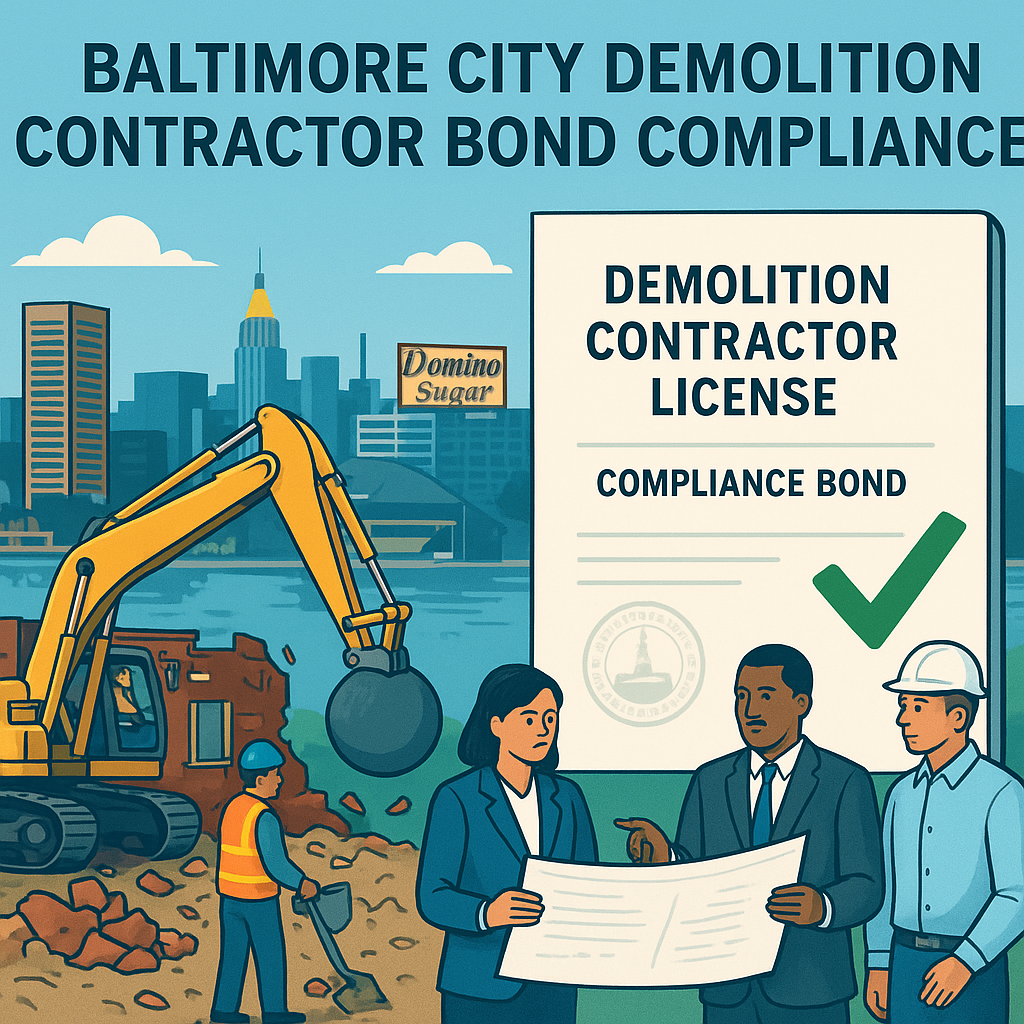
If you’re a demolition contractor in Charm City, you’ve probably heard rumblings about a new compliance twist. Maybe you spotted the phrase “Baltimore City Razing Contractors Single Bond” while renewing your license, or a colleague mentioned that the old way of doing things is, well, old. Change can feel overwhelming, especially when it involves paperwork and surety bonds. But here’s the silver lining: this new requirement isn’t a roadblock. It’s a carefully designed layer of protection—for you, for property owners, and for the neighborhoods you work in. Let’s walk through what this single bond means, why Baltimore made the switch, and how you can check off compliance without losing sleep.
What Is a Baltimore City Razing Contractors Single Bond, Exactly?
Think of a surety bond as a promise sealed with a financial backbone. When Baltimore issues you a “Single Razing Contractors Bond,” it’s not insurance for your business. Instead, it’s a three-party agreement that guarantees you’ll follow the rules. The parties are: you (the contractor), the City of Baltimore (the obligee), and a surety company (the financial backer). If you skip a safety step, fail to clean up debris properly, or violate local demolition codes, the bond kicks in to make things right. The city, or an affected property owner, can file a claim, and the surety pays up to the bond amount. Then you repay the surety—so it keeps you accountable.
This isn’t a completely alien concept. Many trades use bonds. But the phrase “Single Razing Contractors Bond” signals a key simplification. Instead of juggling separate bonds for every individual demolition job, Baltimore now requires one blanket bond that covers your work across multiple projects. It’s like a season pass to a park rather than buying a ticket every single time you want to enter. That one bond, once secured, becomes your ongoing compliance partner.
Why Baltimore Made the Shift to a Single Bond
Baltimore’s housing stock is rich with history, but it also comes with aging row homes, vacant structures, and tight urban lots. Demolition, or “razing,” isn’t just about knocking down walls. It involves protecting adjacent properties, controlling dust that may contain lead paint residue, and making sure utility lines are properly disconnected. The city’s Department of Housing and Community Development (DHCD) realized that tracking compliance on a project-by-project basis created administrative headaches and gaps in oversight.
By rolling requirements into a Baltimore City Single Razing Contractors Bond, officials can see at a glance whether a contractor is authorized to operate. The bond acts as a universal stamp of credibility. It tells homeowners and developers that a razing contractor has met the city’s financial responsibility threshold. It also streamlines enforcement. If something goes wrong on a job site, there’s one clear avenue for recourse instead of hunting down a bond that may have only been valid for that one address.
Who Needs to Pay Attention?
Does your business touch demolition—even partially? If you hold a license to perform razing work within Baltimore City limits, you’ll almost certainly need to nail down this compliance. That includes general contractors who occasionally take on teardowns, specialized demolition firms, and even subcontractors in some scenarios. The rule centers on any activity classified as “razing” under the Baltimore City Building, Fire, and Related Codes.
Even if you’ve been working in Baltimore for decades, don’t assume you’re grandfathered in. The new single bond requirement represents a deliberate departure from older, piecemeal rules. Renewal season is a common time to discover the shift when the city asks for proof of your Baltimore City Razing Contractors Bond. If you’re starting fresh, you’ll be asked for it before your license is issued. So whether you’re a veteran demolishing a commercial block or a newcomer tackling a garage tear-down, this applies to you.
How the Single Bond Stands Apart from Previous Rules
Before this update, Baltimore often used a per-project bonding model. You’d have to secure a separate bond each time you pulled a demolition permit. Imagine if your cell phone provider charged you a new contract for every call—tedious, right? The administrative load was heavy, and the risk of a lapse increased if a contractor forgot to renew a bond for a single job. The city also had to sift through mountains of paperwork.
The Baltimore City Single Razing Contractors Bond flips that model on its head. It’s a continuous bond that typically stays in force as long as you maintain your license and pay the premium. The coverage amount isn’t tied to one address; it’s a fixed sum set by the city, often reflecting the scope of work a contractor is permitted to handle. That means fewer trips to your agent, fewer stacks of bond forms, and a smoother path from quote to job site.
Breaking Down the Compliance Checklist
You’re busy, so let’s make this practical. How do you go from “I just heard about this” to “fully compliant” without pulling your hair out? Here’s a friendly roadmap:
- Verify your license category. Visit the DHCD website or call the permit office to confirm that your current license requires the single razing bond. Ask for the exact bond amount Baltimore mandates for your tier of work.
- Reach out to a surety bond specialist. Not all agents understand the nuances of Maryland demolition bonds. Work with an agency experienced in Baltimore City contractor bonds. They’ll know the filing process, the city’s specific form, and any rider language required.
- Gather your business documents. You’ll typically need your license number, business financials (credit score matters), and possibly a personal financial statement for smaller companies. The stronger your financial picture, the lower your premium.
- Pay the premium and get filed. Once approved, your surety issues the bond. You’ll receive a copy, and the original or a certified copy gets filed with the city. Many agencies now offer electronic filing, speeding up the process.
- Set a renewal reminder. Most bonds are annual. Sync the expiration date with your calendar so your compliant status never lapses. A lapse could halt your next permit in its tracks.
What Does a Baltimore City Razing Contractors Single Bond Cost?
You don’t need to pay the full bond amount out of pocket. Think of it like a home mortgage: you only put down a fraction, and the bank trusts you for the rest. For a demolition contractor bond, you’ll pay a premium—typically between 1% and 5% of the total bond sum. So if Baltimore requires a $10,000 bond, your annual cost might hover between $100 and $500, depending on your creditworthiness and business history.
Contractors with excellent credit often land at the lower end of that scale. If your credit has a few bumps, don’t panic. Specialty surety markets exist for folks with less-than-perfect scores, and the premium might still be manageable. The key is to start early. Waiting until the deadline could leave you scrambling and facing higher rush fees. Budget for this premium as a predictable line item—it’s far cheaper than a fine or a suspension digging into your revenue.
The Real-World Impact: A Quick Story
Let’s paint a picture. Imagine a small Baltimore razing contractor, let’s call him Marcus. He lands a contract to take down a fire-damaged rowhouse on the east side. Marcus does everything by the book, but during the pull, an unforeseen brick fall damages the neighbor’s shared wall. Previously, sorting out who covers the repair could devolve into finger-pointing and drawn-out disputes. Because Marcus holds his Baltimore City Single Razing Contractors Bond, the neighbor can file a claim. The surety investigates, pays the legitimate damages quickly, and Marcus’s business doesn’t get bogged down in lawsuits. He repays his surety over time and keeps his reputation intact. The bond transformed a potential business-killer into an annoyance he can handle.
This isn’t a fairy tale—it’s exactly the kind of protection the city envisioned. The bond acts like a shock absorber for the inevitable bumps that demolition work can bring.
What Happens If You Don’t Play by the Rules?
Let’s be blunt. Operating without the required Baltimore City Single Razing Contractors Bond is a gamble you don’t want to take. The repercussions can escalate quickly:
- Permit denials. You show up at the permit counter, and your application stalls. No bond, no permit. Work grinds to a halt.
- Fines and penalties. The city can levy monetary penalties for unlicensed or non-compliant demolition activity, and those fines can stack per day.
- License suspension or revocation. Repeat issues or willful non-compliance could cost you your ability to work in Baltimore at all.
- Personal liability. Without a bond, if something goes wrong—property damage, environmental contamination, an injury—you’re personally on the hook. Your business assets and even personal savings could be exposed.
Compliance isn’t just a bureaucratic hoop; it’s a shield. It tells clients, “I’m responsible, I’m vetted, and I stand behind my work.”
Demystifying the “Compliance Only” Mindset
Some contractors look at the bond as a “compliance only” checkbox—something they buy, file, and forget. While the minimal aim is indeed compliance, a shift in mindset can transform the bond from an expense into a marketing asset. You can truthfully advertise that you’re fully bonded and licensed in Baltimore City. That short phrase can tip a homeowner’s decision your way, especially when they’re nervous about a demolition near their family’s home. In an industry where trust is everything, the MD City of Baltimore Razing Contractors Bond becomes part of your brand’s safety story.
Frequently Asked Questions, Answered Casually
Is this bond the same as general liability insurance?
No, and that trips up many folks. Insurance protects your business from accidents, theft, or injuries. The bond protects the public and the city from your failure to follow specific laws and regulations. They’re two different tools, and you’ll likely need both.
Can I use one bond for both Baltimore City and Baltimore County work?
Not automatically. Baltimore City is a separate jurisdiction with its own rules. If you work in multiple Maryland counties, check each one’s bonding requirements. Your single razing bond is specific to the City of Baltimore unless your surety has a rider that extends coverage elsewhere, which is rare.
How quickly can I get the bond?
If your paperwork is in order and your credit is solid, many agents can turn around a quote within hours and issue the bond the same day. Electronic filing with the city speeds that final step dramatically. Even with credit challenges, a few days is realistic.
Will the required bond amount increase over time?
It’s possible. Cities adjust bond amounts to match inflation and risk assessments. Always read renewal notices from DHCD and chat with your bond agent about any pending changes.
Partnering with the Right People
Navigating Baltimore’s demolition landscape doesn’t have to be a solo mission. Build a small support team: a bond agent who knows the city’s ins and outs, an attorney who understands Maryland contractor law if you have complex questions, and the permit office itself, which can be surprisingly helpful when you approach early and respectfully. When everyone is rowing in the same direction, that single bond becomes just one oar in a steady boat.
The Bottom Line: Embracing the New Standard
Baltimore’s move to a Baltimore City Razing Contractors Single Bond is a response to a growing city with deep-rooted history and safer demolition practices. It trades complexity for clarity, and scattered obligations for one straightforward policy. Instead of viewing it as yet another government hoop, embrace it as a framework that keeps neighborhoods safer and your business disputes manageable.
So, are you ready to turn compliance into confidence? Reach out to a surety professional, get your bond in place, and step onto your next job site knowing you’ve done things right. In a city where every brick tells a story, you’ll be the contractor who writes the next chapter responsibly—with all the paperwork to prove it.