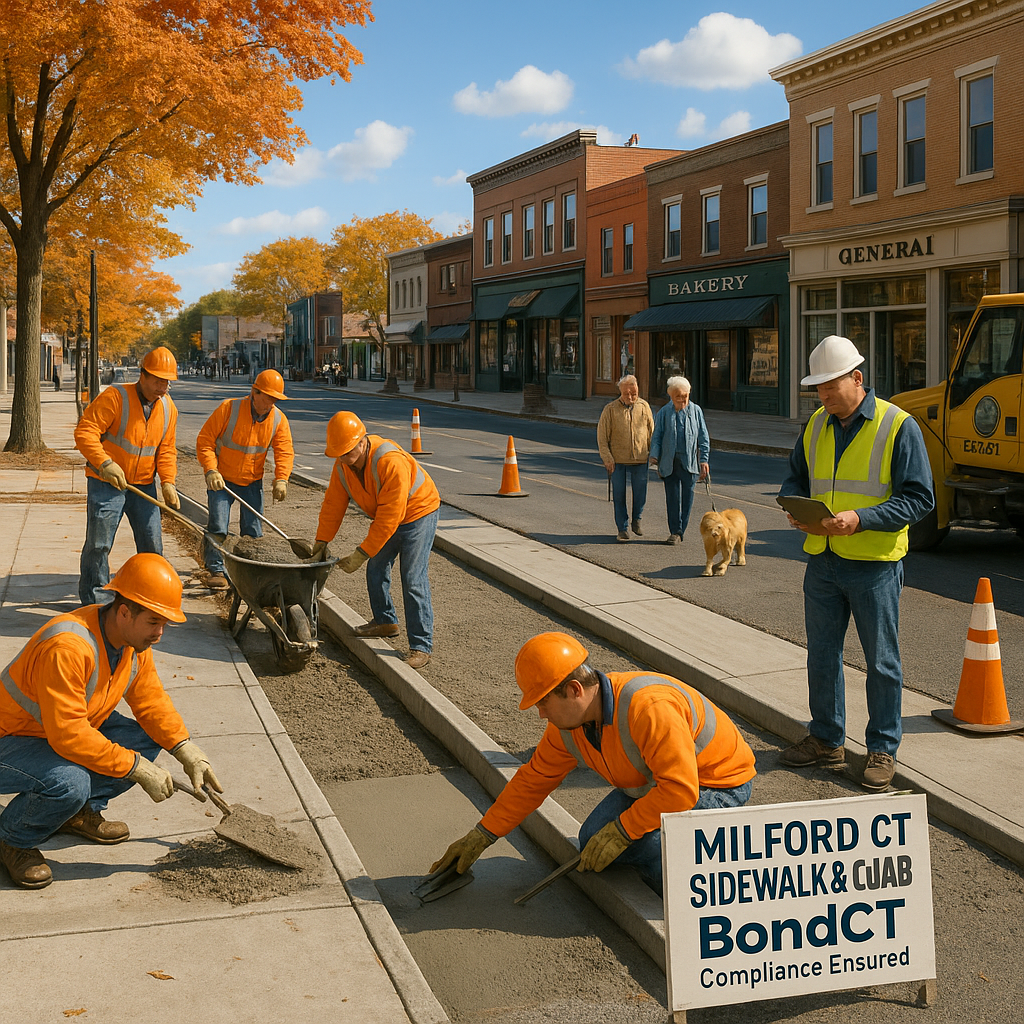
Have you ever tripped on a cracked sidewalk while out for a stroll? It’s startling, a little embarrassing, and sometimes even dangerous. In Milford, Connecticut, city officials take these risks seriously. They know that smooth, well-built walkways and curbs aren’t just about curb appeal—they’re a fundamental part of a safe, connected community. That’s why the City of Milford asks sidewalk and curb contractors to secure a specific type of financial guarantee: the Milford CT sidewalk and curb layer bond. It’s a tool that keeps everyone accountable, ensuring that every new path meets the city’s high standards.
If you’re a homeowner planning a repair or a contractor hoping to work in this picturesque coastal city, understanding this compliance requirement can save you a mountain of hassle. So, let’s break it down in plain, everyday language. Think of this as your friendly guide to the bond, why it exists, and how it protects both your wallet and your morning jog.
What Exactly is a Sidewalk & Curb Layer Bond?
Imagine you’re hiring someone to build a new concrete walkway in front of your home. You’d want a promise that the job will be done correctly, right? A sidewalk and curb layer bond is essentially that promise, but backed by a third party. It’s a type of surety bond that involves three parties: the contractor (the one doing the work), the city (the one requiring the work to be up to code), and a surety company (the financial backer).
Here’s the simple analogy: It’s like a security deposit you might put down on a rental car. The city says, “We trust you’ll follow the rules of the road, but if you return the car with damage we didn’t cause, this deposit covers it.” A compliance bond works the same way. The contractor doesn’t have to pay the full bond amount to get a permit. Instead, they pay a small yearly premium, usually a percentage of the total, and the surety company vouches for them. If the contractor fails to follow Milford’s construction codes, the bond can be used to correct the mistakes without draining taxpayer money.
Why Milford Takes a Compliance-Only Approach
You might notice the term Compliance Only attached to these bonds. That’s not just extra jargon—it clarifies the bond’s laser focus. Unlike a broad performance bond that might cover a contractor’s bankruptcy or a missed deadline, a compliance-only bond zeroes in on one thing: adhering to local regulations. Milford’s city engineers have a detailed set of specifications covering concrete thickness, drainage slopes, and the proper mix of materials. A compliance bond ensures that the final product won’t become a tripping hazard six months later because someone cut corners.
This approach makes life easier for everyone. Contractors know exactly what is expected. Inspectors can measure the work against a clear set of rules. And residents get a durable, safe pathway without having to become concrete experts overnight. It’s a system built on transparency.
A Promise That Protects More Than Pavement
Without this requirement, a poorly poured curb could lead to water pooling on your property, ice patches in winter, or even a serious fall. The bond acts as a financial backstop. It guarantees that if a contractor walks away leaving behind work that doesn’t meet code, funds are available to hire another crew to fix it. This protection isn’t hypothetical. It’s a real safety net that keeps property values stable and makes Milford’s downtown and neighborhoods more walkable for everyone, from parents pushing strollers to seniors enjoying an afternoon walk.
How a Contractor Secures a Bond in Milford
If you’re a contractor reading this, the process is more approachable than you might think. First, you’ll reach out to a surety bond agency that is licensed to write bonds in Connecticut. You’ll fill out an application, and the agency will run a soft credit check. They’re looking for signs of reliability. The better your credit and business history, the lower the premium you’ll pay. For many sidewalk contractors in Milford, the annual premium is just a small business expense—often between 1% and 3% of the total bond amount the city mandates.
Once approved, you’ll receive a bond certificate. You submit this to the City of Milford along with your permit application. After the city verifies everything, you’re free to get to work, break ground, and start pouring. The bond stays on file, active for the duration of your license or project, acting as your silent partner in credibility. Homeowners love to see that certificate because it transforms you from an unknown into a trusted professional.
What This Means for Homeowners and Business Owners
Are you planning a project that touches the public right-of-way? Perhaps you need to replace a cracked apron at the end of your driveway, or a section of curb was damaged by winter plows. When you hire a contractor, asking the simple question, “Are you bonded with the city?” opens the door to a much safer transaction. A legitimate contractor will proudly share their compliance bond details.
Here’s a practical checklist for you:
- Ask for proof of the bond. A reputable contractor will have the document ready.
- Verify with the city. Milford’s building or engineering department can confirm if a bond is current.
- Read reviews and look at past work. The bond covers code compliance, but you still want a craftsman who takes pride in their finish.
- Get a written contract. Outline the scope of work, timeline, and materials to match what the city requires.
When all these pieces click together, you’re not just repairing concrete. You’re investing in peace of mind, and you’re contributing to the network of safe pathways that makes Milford such a charming place to live.
The Real Cost of Skipping Compliance
Maybe you’ve come across a contractor who offers a cash discount to skip the permit and bond process. It can be tempting. After all, who doesn’t love saving money upfront? But cutting corners here often leads to steep consequences down the road. If the city discovers unpermitted work, they can issue a stop-work order, levy significant fines, and require you to tear out non-compliant concrete at your own expense. That “bargain” can quickly double the original project’s cost.
Worse, if someone trips on an improperly installed panel and gets injured, liability could land squarely on your shoulders. The bond acts as a shield. When a bonded contractor does the job, the paper trail confirms that a certified professional performed the work to the city’s exact standards. That documentation is invaluable if an insurance claim ever arises. You’re not just protecting your sidewalk; you’re protecting your financial future.
How Milford’s System Elevates Community Safety
When a city insists on sidewalk and curb compliance bonds, it’s sending a message: public safety is non-negotiable. Milford’s streets are lined with century-old trees in some neighborhoods, and roots can wreak havoc on slabs. By requiring bonded professionals, the city ensures that every repair, no matter how small, is engineered to last. The curb ramps at intersections will meet accessibility standards. The cross slopes will drain properly. The visual beauty of a uniform streetscape tells visitors that this is a community that cares.
Think about your last walk through Silver Sands State Park or the downtown green. The experience is seamless partly because the infrastructure quietly supports every step. That seamless quality doesn’t happen by accident. It’s the fruit of a strong compliance framework that starts long before the first wheelbarrow of concrete arrives. The Milford CT sidewalk and curb layer bond is that starting point.
Building a Collaborative Future, One Block at a Time
At its core, the bond requirement strengthens the relationship between residents, contractors, and the city. Contractors gain a mark of trust that sets them apart from unlicensed operators. The city maintains control over its long-term infrastructure quality without stretching its inspection resources to the breaking point. Residents enjoy safer streets and a clearer path to resolving disputes, should they ever arise. It’s a rare win in municipal regulation where everybody benefits.
So, the next time you notice fresh concrete on your street, you’ll see more than just gray pavement. You’ll see a promise made solid. A compliance-only bond in Milford, Connecticut, transforms sidewalks from simple walkways into reliable threads that stitch the community together. Whether you’re driving a stroller, rolling a wheelchair, or simply taking your golden retriever for a walk, that promise means you can step forward with confidence.
If you’re ready to start a project, reach out to a local surety agent or the City of Milford’s building department for the latest bond requirements. A short conversation today can prevent years of headaches, and it supports a city that truly keeps its pathways safe, one sturdy slab at a time.